At a glance
This smoky paprika butter bean stew is a six-portion fall recipe built around olive oil, vegetables and a deliberately measured seasoning base. Large beans remain whole in a thick smoky tomato sauce with tender peppers.
Allow about 15 minutes for preparation and 35 minutes for cooking (50 minutes total). Start with the prepared ingredient states listed below; cooking dried beans from scratch is additional time. The clock is a planning estimate: the tenderness cues decide when the food is ready.
Use a 5- to 6-quart heavy pot, a chopping board, a sharp knife, a kitchen scale and a ladle. A food thermometer helps check reheated portions.
Table of Contents
Table of Contents
Why this fall dinner works
Big, creamy butter beans soak up a smoky paprika and tomato sauce, so this stew feels rich and satisfying without any meat.
The measured water base lets the vegetables and seasonings lead, without making the result depend on an unspecified stock cube or salty carton. Olive oil carries the aromatics, the main ingredients give the bowl its body, and the finishing acid brings the flavors into focus. If you choose broth, taste before using all the measured salt.
This is a useful dinner to put on the table after an autumn walk or a busy afternoon. Prepare the vegetables before turning on the heat, keep the finishing ingredients separate, and use the method’s texture cues to avoid guessing from the timer alone.
Recipe background and flavor
This Mediterranean-inspired recipe combines butter beans, canned tomatoes, red bell peppers, smoked paprika, dried oregano and fresh lemon juice. Butter beans are large lima beans; the large-seeded type was first grown in the Andes of South America, and the name comes from Lima, Peru. In Greece, giant white beans baked in tomato sauce with herbs are known as gigantes plaki, and butter beans are a common stand-in outside Greece. Smoked paprika comes from Spain, where the best-known kind, pimentón de la Vera, is made from peppers dried slowly over oak fires. The combination is a house recipe rather than a traditional regional dish.
The fall-harvest setting describes when you might serve it. Follow the preparation states and finishing sequence below to keep the texture and flavor intended for this version.
What to buy for this soup
Start with cooked large lima/butter beans, drained, unsalted: the batch needs 900 g in the prepared state. Dice the red bell peppers into 1/2-inch pieces and drain the cooked large lima beans, often sold as butter beans.
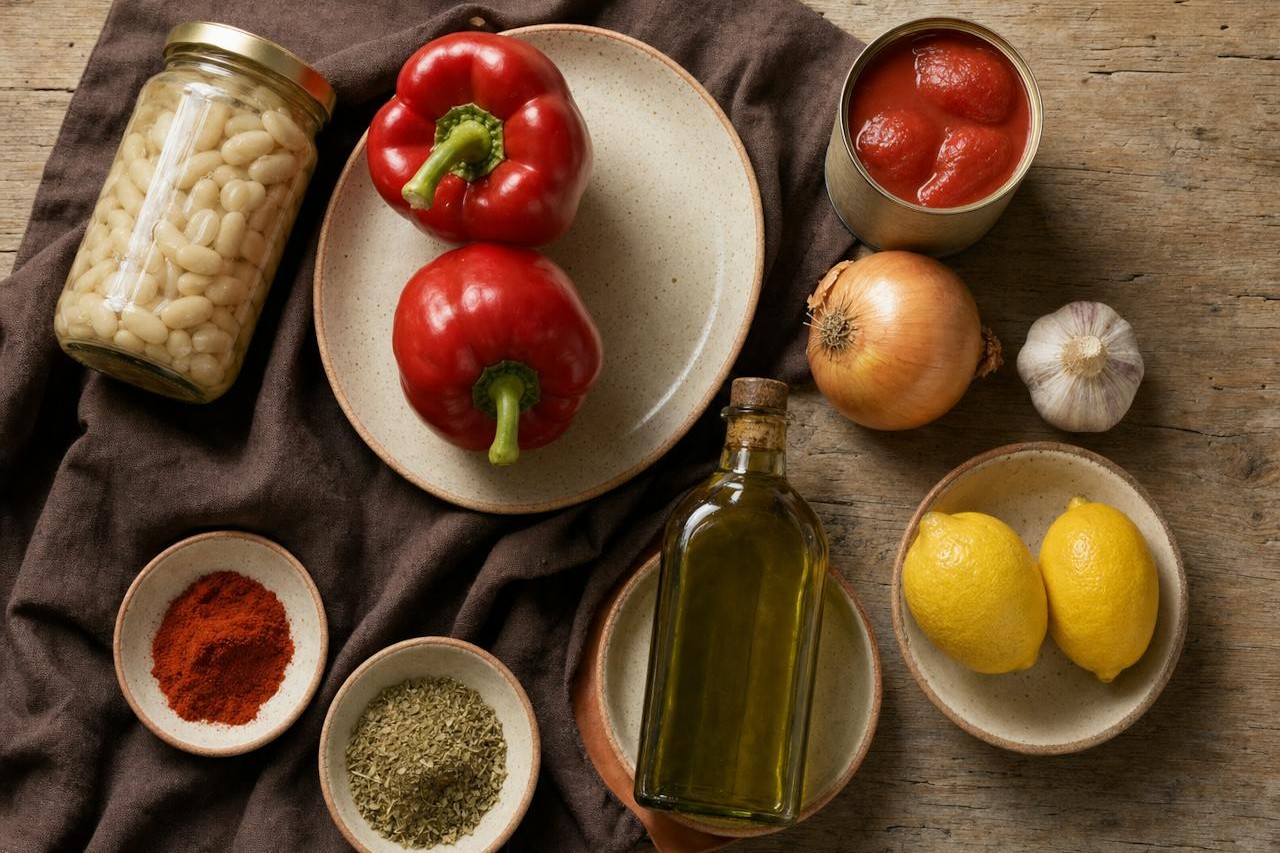
Look for cans or jars labeled butter beans or large lima beans, and pick a smoked paprika labeled sweet (dulce) to keep the stew mild. Cannellini beans work at the same cooked weight but make a smaller-bean stew with a different estimate.
Buy the ingredient forms in the recipe card, then measure after peeling, trimming or draining where specified. Keep fresh produce and cooked legumes distinct from dry legumes; the preparation states are part of the method.
Ingredients and substitutions
Weigh vegetables after removing inedible cores, tough stems, seeds or peel where specified. Water is measured in milliliters. Grams are the controlling measure; spoon and cup conversions are approximate. Use the complete ingredient list in the recipe card when shopping.
Cooked beans and chickpeas mean fully tender legumes that have already been prepared and drained. Do not put dry beans into a method written for cooked beans. For canned alternatives, rinse and drain, weigh the solids, then adjust salt to the label and your taste. The nutrition calculation uses unsalted cooked legumes.
Cannellini beans work at the same cooked weight but make a smaller-bean stew with a different estimate.
Allergen notes: No US major allergen intentionally included in the base; check purchased ingredients and cross-contact.
| Ingredient | Amount |
|---|---|
| extra-virgin olive oil | 27 g (about 2 tbsp) |
| yellow onion, diced | 150 g |
| garlic, minced | 12 g |
| cooked large lima/butter beans, drained, unsalted | 900 g |
| no-salt-added canned tomatoes with juice | 800 g |
| red bell peppers, seeded | 300 g |
| smoked paprika | 4 g |
| dried oregano | 1 g |
| fresh lemon juice | 30 g (about 2 tbsp) |
| fine salt | 6 g (about 1 tsp) |
| water | 500 ml |
How to make it
- Dice the red bell peppers into 1/2-inch pieces and drain the cooked large lima beans, often sold as butter beans.
- Heat the olive oil over medium heat. Add the onion and cook 6–8 minutes, stirring, until softened but not deeply browned. Add diced red bell pepper and cook 3 minutes more.
- Add the minced garlic, smoked paprika and dried oregano and stir for 30 seconds, just until fragrant.
- Add the drained cooked butter beans, the canned tomatoes with their juice, 500 ml water and the 6 g salt. Bring to a boil, then reduce to a gentle simmer with the lid partly covering the pot. Cook about 25 minutes, stirring occasionally and checking tenderness. Keep enough liquid around the solids; add a little hot water if the pot becomes dry.
- Fold the beans gently to keep their skins intact and finish with lemon juice.
- Check the finished texture: Large beans remain whole in a thick smoky tomato sauce with tender peppers. Taste a spoonful after it cools slightly; extra salt, oil or toppings are optional and change the nutrition estimate. Stir the whole pot before dividing into six equal portions.
What makes the texture work?
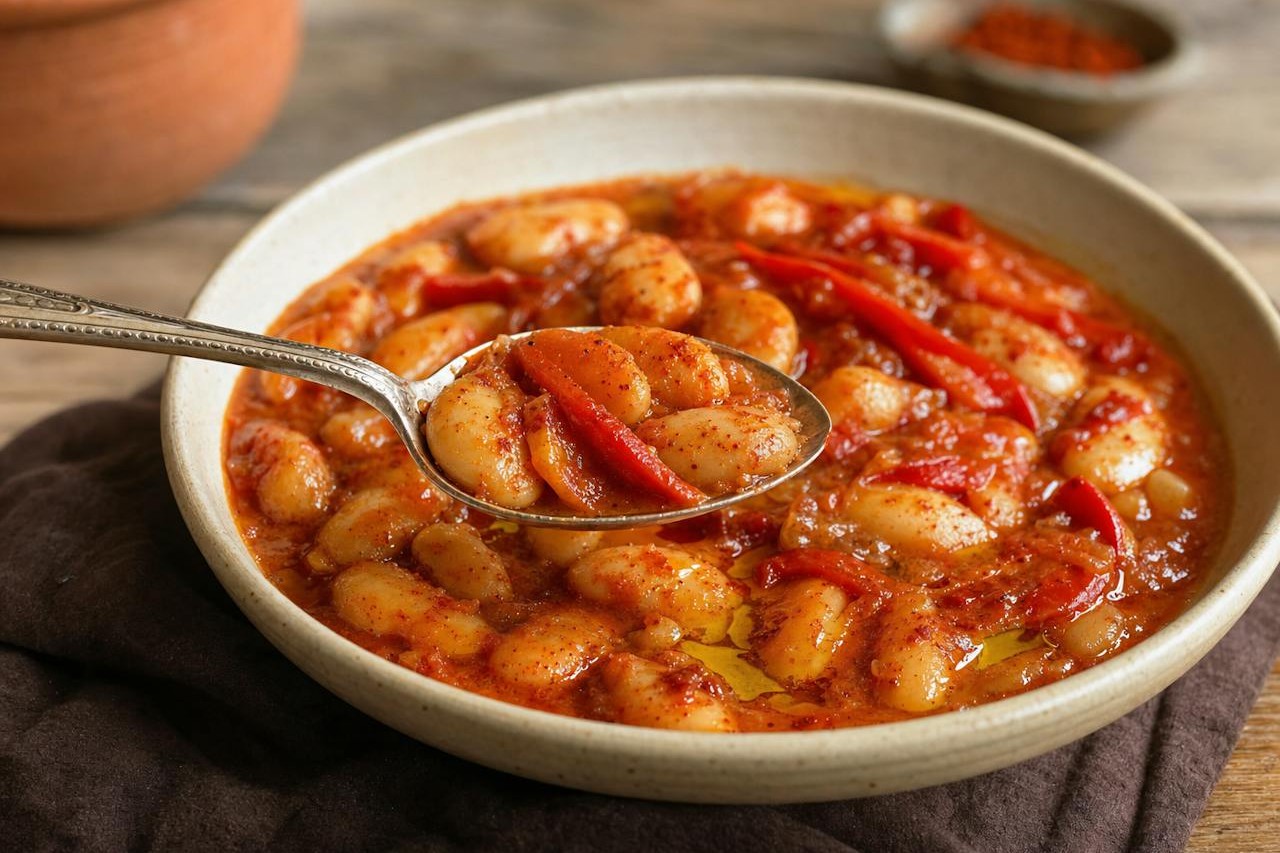
Large beans remain whole in a thick smoky tomato sauce with tender peppers.
Dice the red bell peppers into 1/2-inch pieces and drain the cooked large lima beans, often sold as butter beans.
The preparation size controls how quickly the center softens. Keep the simmer steady so the outside does not break down while the center is still firm. Fold the beans gently to keep their skins intact and finish with lemon juice.
Cooking walkthrough
Stage 1: Dice the red bell peppers into 1/2-inch pieces and drain the cooked large lima beans, often sold as butter beans. Heat the olive oil over medium heat. Add the onion and cook 6–8 minutes, stirring, until softened but not deeply browned. Add diced red bell pepper and cook 3 minutes more.
Stage 2: Add the minced garlic, smoked paprika and dried oregano and stir for 30 seconds, just until fragrant.
Stage 3: Add the drained cooked butter beans, the canned tomatoes with their juice, 500 ml water and the 6 g salt. Bring to a boil, then reduce to a gentle simmer with the lid partly covering the pot. Cook about 25 minutes, stirring occasionally and checking tenderness. Keep enough liquid around the solids; add a little hot water if the pot becomes dry.
Stage 4: Fold the beans gently to keep their skins intact and finish with lemon juice. Check the finished texture: Large beans remain whole in a thick smoky tomato sauce with tender peppers. Taste a spoonful after it cools slightly; extra salt, oil or toppings are optional and change the nutrition estimate. Stir the whole pot before dividing into six equal portions.
Four stages at a glance
- Dice pepper; drain cooked butter beans.
- Soften onion, pepper and garlic.
- Add tomatoes and beans; simmer gently.
- Keep beans intact; finish with lemon.
This short guide summarizes the sequence. Use the full method and recipe card for the complete ingredient list, quantities, temperature settings and timing cues.
Check texture, not just the timer
Large beans remain whole in a thick smoky tomato sauce with tender peppers.
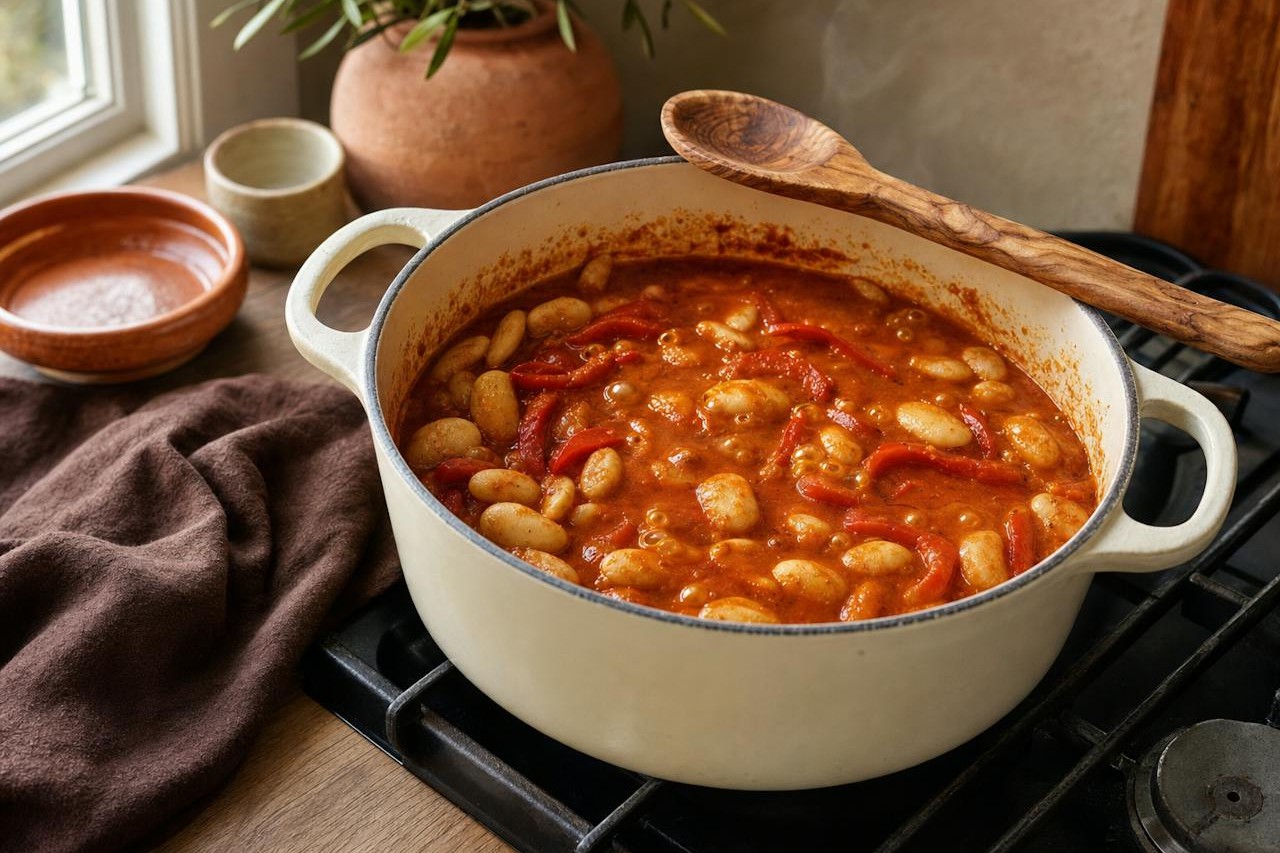
Check a piece from the middle of the pot, not only one floating at the edge. A simmer should look like steady small bubbles; a hard boil can break up delicate vegetables and legumes before the center of a larger piece softens. Stir across the bottom of the pot to catch sticking early.
If the soup has reduced too far, add hot water a little at a time, stir and reassess. If it is too thin but the solids are tender, simmer uncovered briefly. Avoid extending the cooking simply to hit a predicted yield.
Ingredients to finished bowl
Before cooking: Dice the red bell peppers into 1/2-inch pieces and drain the cooked large lima beans, often sold as butter beans.
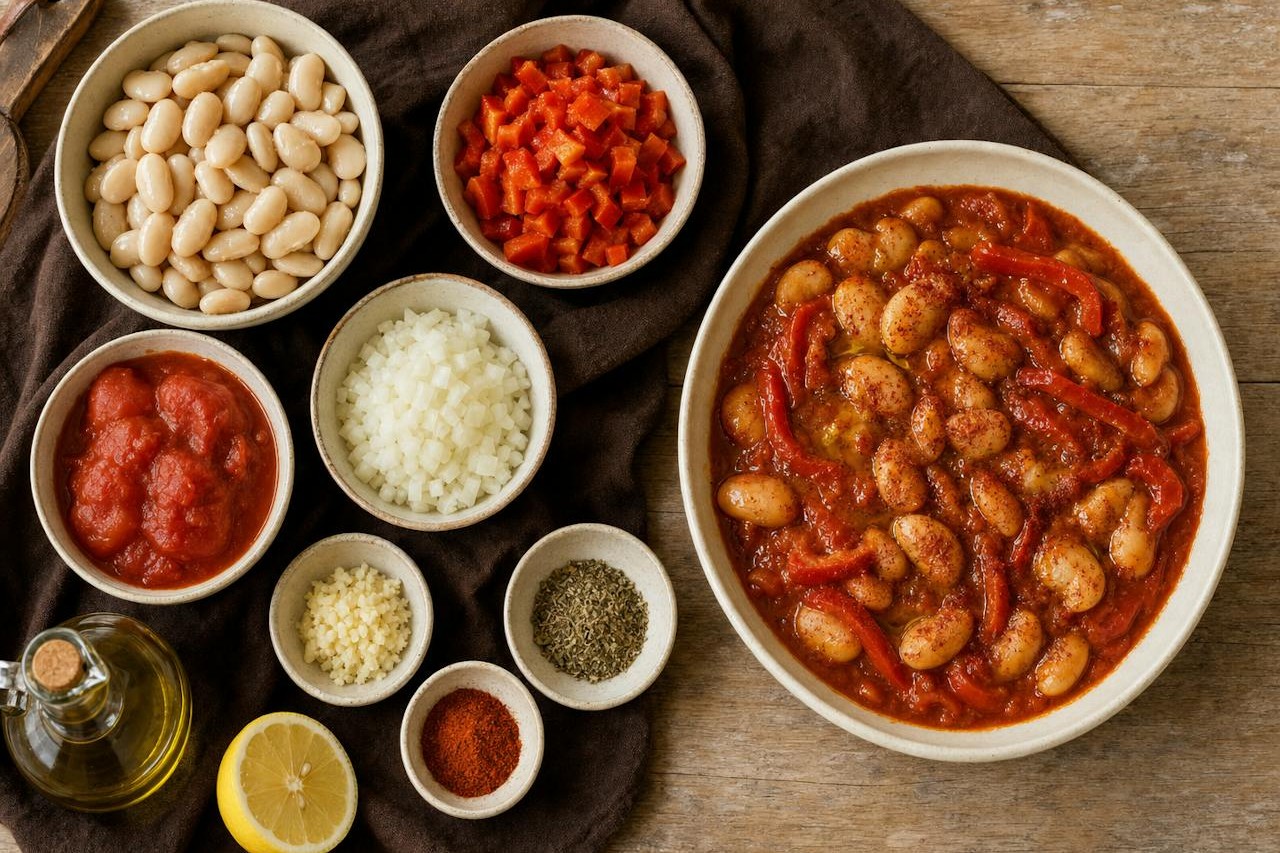
During cooking: Add tomatoes and beans; simmer gently.
Finished bowl: Large beans remain whole in a thick smoky tomato sauce with tender peppers.
Final flavor: Fold the beans gently to keep their skins intact and finish with lemon juice.
Five checks for this soup
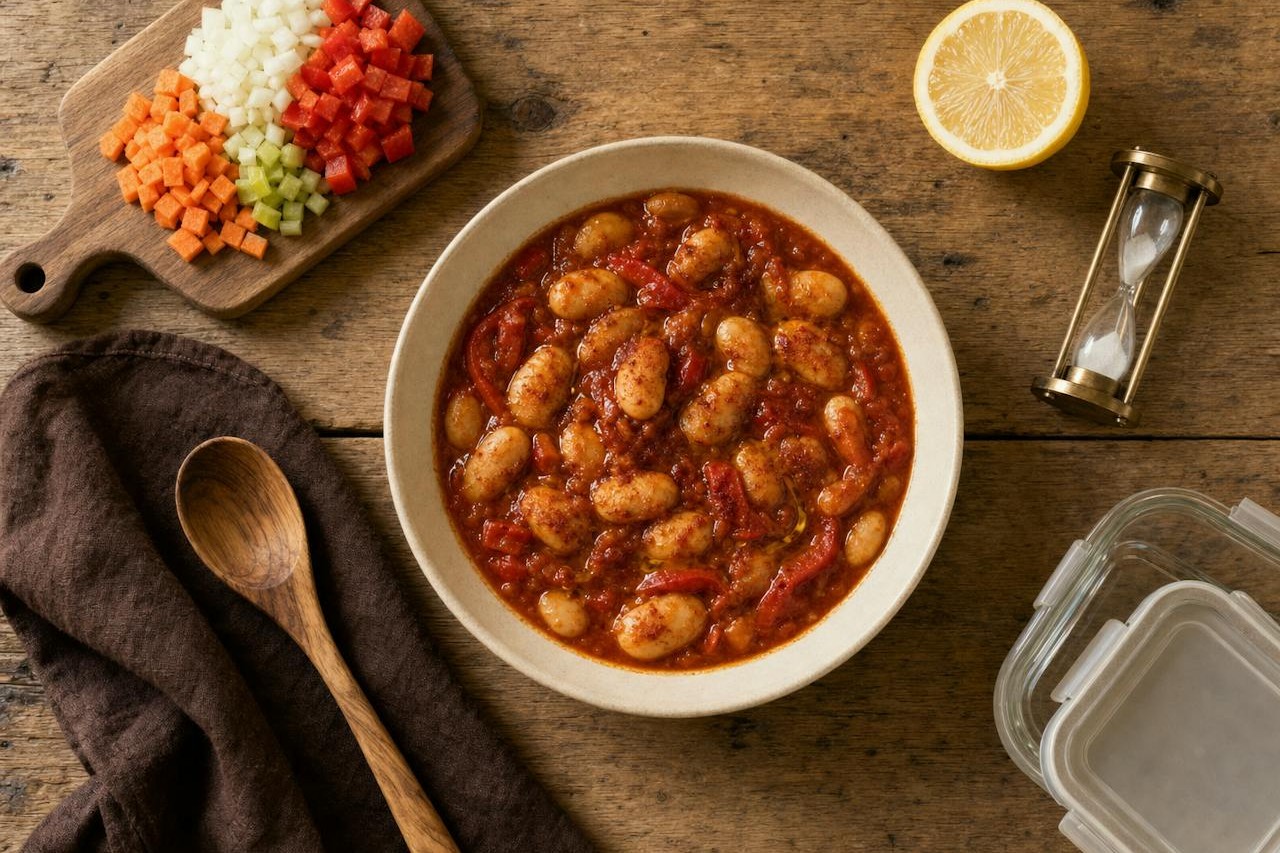
- Cut evenly: Dice the red bell peppers into 1/2-inch pieces and drain the cooked large lima beans, often sold as butter beans.
- Simmer gently: Use steady small bubbles and stir across the bottom. Add hot water a little at a time only if the soup becomes too thick.
- Test the center: Large beans remain whole in a thick smoky tomato sauce with tender peppers. Paprika scorches quickly; stir it into the soft vegetables briefly, then add tomatoes immediately.
- Finish in order: Fold the beans gently to keep their skins intact and finish with lemon juice.
- Chill promptly: Portion leftovers into shallow containers and refrigerate within 2 hours, or 1 hour above 90°F. Keep at 40°F or below; use within 3–4 days.
Troubleshooting
Paprika scorches quickly; stir it into the soft vegetables briefly, then add tomatoes immediately.
A flat-tasting bowl may need the measured finishing acid rather than more salt. First taste a spoonful that has cooled slightly, check that all specified ingredients went in, then adjust in small increments. If the soup is already too salty, dilute with unsalted water and additional cooked unsalted ingredients; a potato does not selectively remove salt.
For scorching, stop stirring and transfer the unburned upper soup to a clean pot without scraping the bottom. A bitter burned layer cannot be reliably hidden with sweetness or extra oil. For a soup that thickens in storage, reheat with a splash of water and stir before deciding whether it needs further adjustment.
Make-ahead, storage and reheating
These storage and reheating limits follow USDA guidance on leftovers. Cool promptly, keep the refrigerator cold and reheat only the portion you need.
Refrigerate in shallow containers within 2 hours of cooking, or within 1 hour above 90°F. Keep the refrigerator at 40°F or below and use leftovers within 3–4 days. Reheat the portion needed to 165°F; bring soup to a rolling boil while stirring. Do not use smell as the safety test.
For planned leftovers, portion the soup before adding crisp toppings. Cool in shallow containers instead of leaving the full heavy pot on the counter. Label the preparation date and refrigerate promptly; do not wait for the food to reach room temperature.
Freezing is an option for later meals, including this smoky paprika butter bean stew: use freezer-safe containers with headspace and label the recipe and date. Start by testing one portion for quality. Bean stews freeze well; the beans may soften slightly after thawing, so reheat gently and stir with care to keep them whole. Thaw in the refrigerator or reheat safely from frozen, stirring frequently.
For a fall gathering, keep hot soup at 140°F or above while serving. Put out modest portions and refill from a safely held pot. The nutrition serving is one-sixth of this recipe, not an assumed cup volume; stir before dividing so solids are shared evenly.
Nutrition facts
The ingredient calculations use USDA FoodData Central. Values are estimates for the stated quantities and six equal servings.
Estimated per one-sixth of the completed batch, using edible input weights and USDA SR Legacy records. Soup liquid is retained; evaporation changes portion weight rather than batch nutrient totals. Generic paprika models smoked paprika. Beans are modeled as cooked without salt; canned brands change sodium. No laboratory measurement or vitamin-retention calculation is claimed. Optional additions are excluded.
The figures below are per one-sixth batch, before any optional side dishes or additional salt. Calculations sum each ingredient’s grams × USDA nutrient value per 100 g ÷ 100, then divide by six. Final cooked yield has not been measured, so a grams-per-serving or cups-per-serving claim is not supplied.
| Nutrient | Estimated per serving |
|---|---|
| Energy | 263 kcal |
| Protein | 13.8 g |
| Carbohydrate | 42.8 g |
| Fiber | 14.9 g |
| Total sugars | 11.1 g |
| Total fat | 5.7 g |
| Saturated fat | 0.9 g |
| Sodium | 408 mg |
| Calcium | 87 mg |
| Iron | 4.9 mg |
| Magnesium | 89 mg |
| Potassium | 1189 mg |
Compare nutrition by portion
One serving means one-sixth of the finished batch, divided so the solids and liquid are shared evenly. Half a serving means one-twelfth of the batch. Two servings mean one-third and three servings mean one-half.
The figures are calculated from the unrounded ingredient totals, then rounded for display. Multiplying a rounded single-serving value may give a slightly different result. Optional accompaniments are excluded.
| Nutrient | ½ serving | 1 serving | 2 servings | 3 servings |
|---|---|---|---|---|
| Energy (kcal) | 132 | 263 | 526 | 789 |
| Protein (g) | 6.9 | 13.8 | 27.6 | 41.3 |
| Carbohydrate (g) | 21.4 | 42.8 | 85.6 | 128.3 |
| Fiber (g) | 7.4 | 14.9 | 29.7 | 44.6 |
| Fat (g) | 2.8 | 5.7 | 11.4 | 17.1 |
| Saturated fat (g) | 0.4 | 0.9 | 1.7 | 2.6 |
| Sodium (mg) | 204 | 408 | 816 | 1224 |
Scale the recipe for your table
The base recipe serves six and uses 900 g cooked large lima/butter beans, drained, unsalted. The table below shows that ingredient as a quick reference. Multiply every other ingredient by the same factor; do not scale only the main ingredient.
For example, three servings need half of every amount in the recipe card. Twelve servings need double every amount. Use a suitably sized pot or split larger batches between pots; cooking time does not multiply in the same way as quantities.
Keep the main ingredient in the same prepared state when weighing. A dry weight is not interchangeable with a cooked or drained weight. Check doneness and divide leftovers into shallow containers promptly.
| Servings | Multiply all amounts by | Main ingredient |
|---|---|---|
| 1 | 1/6 | 150 g |
| 2 | 2/6 | 300 g |
| 3 | 3/6 | 450 g |
| 4 | 4/6 | 600 g |
| 6 | 6/6 | 900 g |
| 8 | 8/6 | 1200 g |
| 10 | 10/6 | 1500 g |
| 12 | 12/6 | 1800 g |
| 18 | 18/6 | 2700 g |
What this bowl contributes
One-sixth batch of this smoky paprika butter bean stew provides approximately 13.8 g protein and 14.9 g fiber on the stated ingredient basis. These are food-composition estimates, not a claim that the recipe treats or prevents a health condition.
How does one bowl fit into a day? Harvard’s Nutrition Source says adults need at least 25 to 35 g of fiber a day, and one serving here provides about 14.9 g. The FDA sets the Daily Value for sodium at less than 2,300 mg; one serving contains about 408 mg with the full measured salt.
Beans, lentils and chickpeas are an inexpensive source of protein, fiber and iron, as the Harvard overview of legumes and pulses explains. Plant (nonheme) iron is absorbed better when eaten with vitamin C foods such as the tomatoes, red bell peppers and lemon juice in this stew, according to the NIH Office of Dietary Supplements. Most of the fat comes from extra-virgin olive oil, which is rich in monounsaturated fat, as Harvard’s guide to types of fat explains.
A vegetable soup can be a starter, a light meal or part of a larger dinner depending on portion and accompaniments. Choose sides according to the meal you want to build. Replacing ingredients, reducing portions or adding toppings changes the nutrient balance; recalculate from the nutrition section when adapting the recipe.
Serving ideas for fall harvest dinners
Round out your smoky paprika butter bean stew: serve it with crusty bread for the sauce, or spoon it over cooked barley.
Planning a soup week? Pair this bowl with our Moroccan chickpea and squash stew or the saffron potato and chickpea stew, and see the Mediterranean diet guide for building balanced fall dinners around legumes and vegetables.
For an informal table, warm the serving bowls while the soup finishes and keep garnish, bread and any dairy topping separate. Guests can then choose the finish they want, and the soup keeps its intended texture. Put the ladle beside the pot and provide enough room for safe serving.
For three servings, halve every ingredient, use a smaller pot and check tenderness rather than halving the cooking time. For twelve, double the formulation and use two pots if your equipment cannot hold the batch safely. A larger batch needs more time to return to a simmer, not automatically twice the time at a simmer.
The recipe in five views
The finished bowl: Large beans remain whole in a thick smoky tomato sauce with tender peppers.
The ingredients: Start with cooked large lima/butter beans, drained, unsalted: the batch needs 900 g in the prepared state. Dice the red bell peppers into 1/2-inch pieces and drain the cooked large lima beans, often sold as butter beans.
The cooking pot: Add tomatoes and beans; simmer gently.
The close-up: check a spoonful for the tenderness described above before finishing.
The table: Serve with crusty bread for the sauce, or spoon it over cooked barley.
Variations and what changes
Cannellini beans work at the same cooked weight but make a smaller-bean stew with a different estimate.
Broth instead of water: replace the same liquid volume, inspect the sodium label and begin with less added salt. The published nutrition is for water and the full measured salt. A richer stock changes both the flavor and the nutrition.
Toppings: treat cream, yogurt, cheese, seeds, nuts, bread and extra oil as additions unless they appear in the measured ingredient list.
Compare the base recipe and variations
Cannellini beans work at the same cooked weight but make a smaller-bean stew with a different estimate.
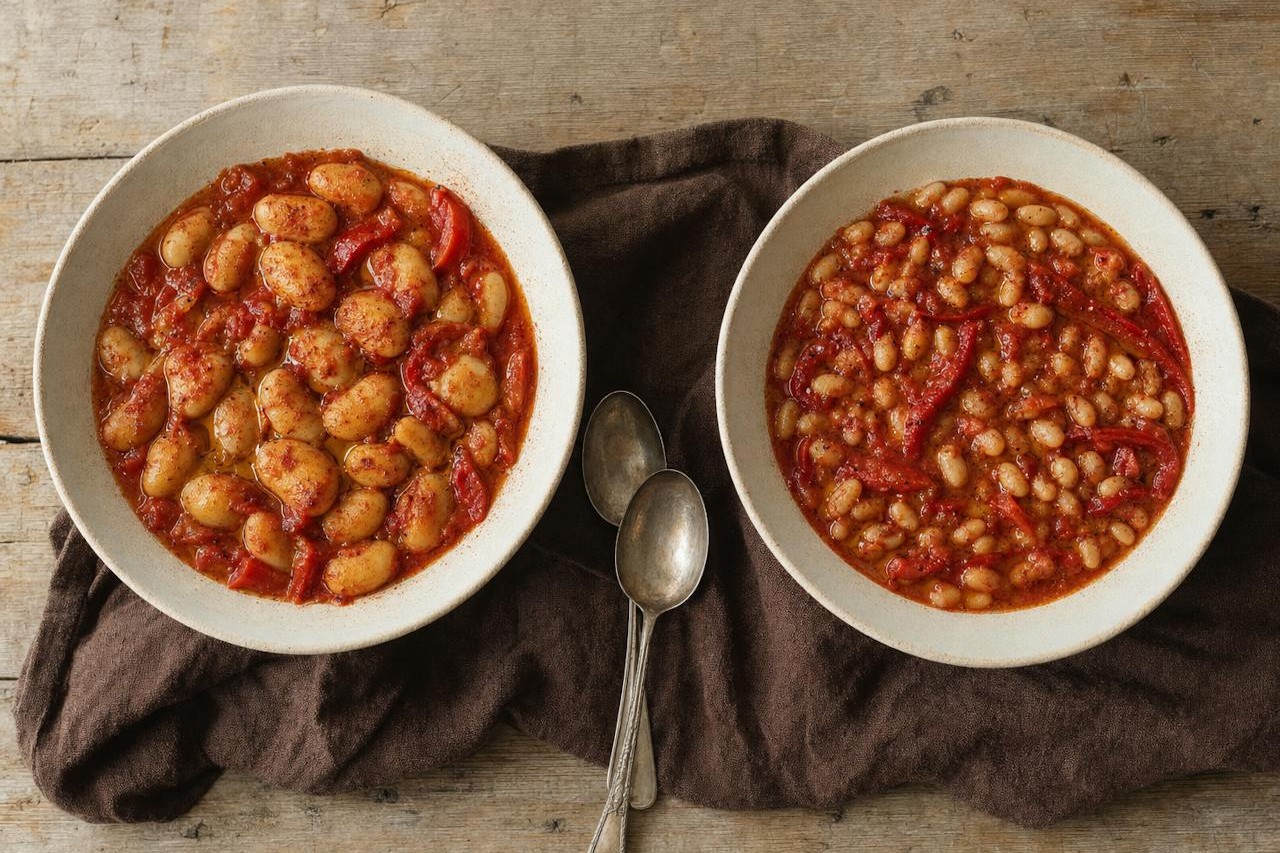
Use this comparison to decide what you want to change before you start. Change one thing at a time so the effect is easier to understand. The published nutrition applies to the base formulation.
| Choice | Base recipe | Alternative | What changes |
|---|---|---|---|
| Liquid | Measured water | Same volume broth | Flavor and sodium; reduce added salt initially. |
| Batch size | Six servings | Three servings | Halve every ingredient; check doneness, not half the clock. |
| Texture | As described | Mash a ladleful of beans | Thicker, creamier sauce; stir it back into the pot. |
| Toppings | Measured ingredients | Extra bread, nuts, cheese or oil | Nutrition and allergens may change. |
| Serving time | Freshly made | Reheated later | Grains and vegetables can soften; loosen if needed. |
Questions before cooking
Can I make this ahead?
Yes. Smoky paprika butter bean stew keeps well in the fridge, and the flavor deepens overnight; follow the handling steps in the storage section. Add a splash of water when reheating because the sauce thickens as it stands.
Can I use dry beans instead of cooked?
Only after cooking them separately until fully tender. The listed cooked weight is not the same as the dry weight. Lentils, split peas, rice, barley and farro are marked dry when the method is designed to cook them in the soup.
Can I double it?
Yes, scale all ingredients together and use adequate pot capacity. Divide into shallow containers promptly if storing a large batch.
Is the nutrition exact?
No. USDA records, ingredient varieties, salt choices and serving distribution create variation. The nutrition section lists the assumptions, and nutrients without reliable data are left out rather than counted as zero.
Smoky Paprika Butter Bean Stew Recipe
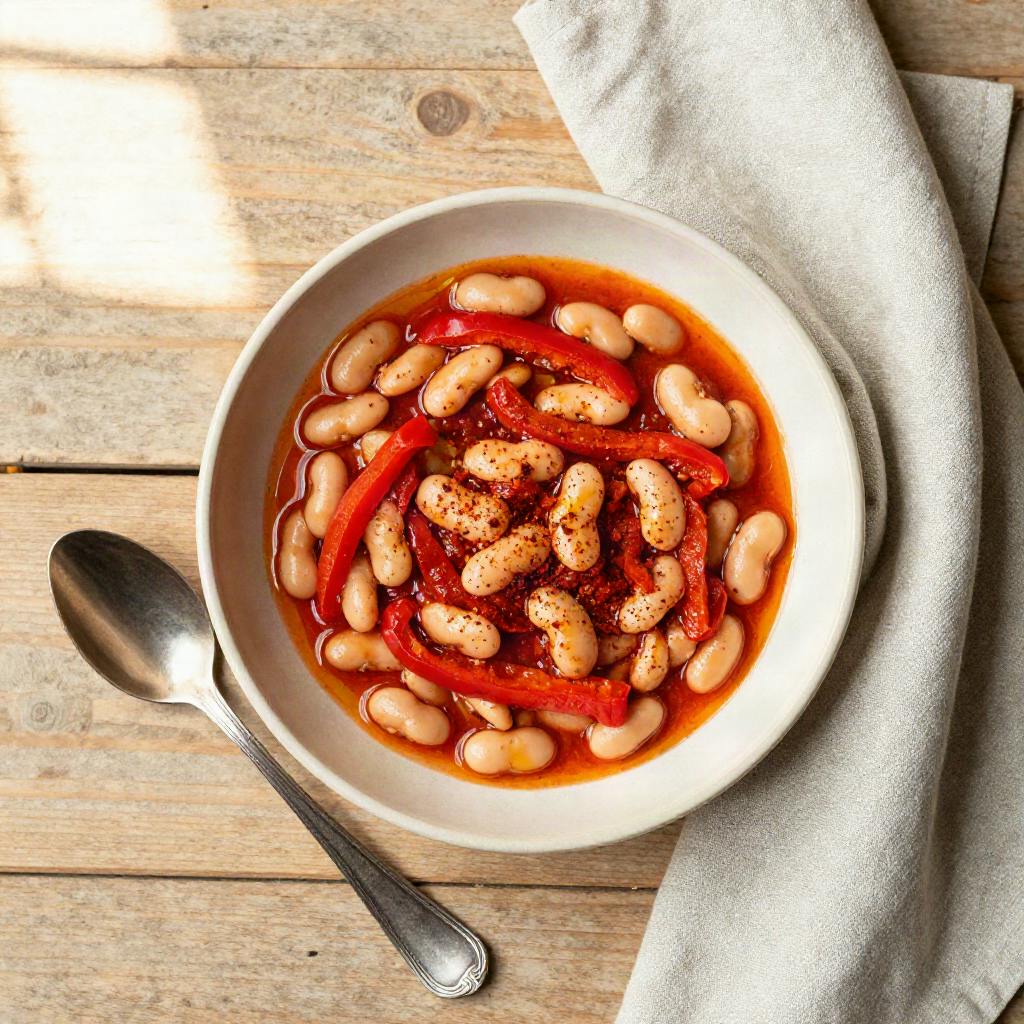
Smoky Paprika Butter Bean Stew
Ingredients
Equipment
Method
- Dice the red bell peppers into 1/2-inch pieces and drain the cooked large lima beans, often sold as butter beans.
- Heat the olive oil over medium heat. Add the onion and cook 6–8 minutes, stirring, until softened but not deeply browned. Add diced red bell pepper and cook 3 minutes more.
- Add the minced garlic, smoked paprika and dried oregano and stir for 30 seconds, just until fragrant.
- Add the drained cooked butter beans, the canned tomatoes with their juice, 500 ml water and the 6 g salt. Bring to a boil, then reduce to a gentle simmer with the lid partly covering the pot. Cook about 25 minutes, stirring occasionally and checking tenderness. Keep enough liquid around the solids; add a little hot water if the pot becomes dry.
- Fold the beans gently to keep their skins intact and finish with lemon juice.
- Check the finished texture: Large beans remain whole in a thick smoky tomato sauce with tender peppers. Taste a spoonful after it cools slightly; extra salt, oil or toppings are optional and change the nutrition estimate. Stir the whole pot before dividing into six equal portions.
Nutrition
Notes
Tried this recipe?
Let us know how it was!About Sofia
Sofia Merraki is a Greek-Italian home cook with a degree in Nutrition Science. Her cooking background spans Greek and Neapolitan family kitchens. She is a nutrition graduate, not a licensed Registered Dietitian.